Agentic AI Explained: How AI Agents Work and Why They Matter in 2026
Artificial Intelligence is evolving beyond answering questions and generating content. Today, AI systems can plan tasks, use tools, interact with APIs, and execute multiple steps to achieve specific goals.
This is where Agentic AI comes in.
In 2026, Agentic AI is gaining attention because businesses are exploring intelligent automation for software development, customer support, data analysis, and business workflows.
In this article, we will explore what Agentic AI is, how AI agents work, their real-world applications, and why developers should understand this technology.
1. What Is Agentic AI?
Agentic AI is an approach to artificial intelligence in which AI systems can pursue defined goals by planning tasks, selecting tools, and taking actions with varying levels of autonomy.
Unlike a traditional chatbot that primarily generates responses, an AI agent can perform multiple steps to accomplish a task.
Example:
- A chatbot explains how to analyze sales data.
- An AI agent retrieves sales data, analyzes performance, identifies trends, and generates a report using authorized tools.
The key difference is the ability to take actions toward a goal rather than simply generate a response.
2. What Is an AI Agent?
An AI agent is a software system that uses AI to understand instructions, select actions, and work toward a specific objective.
An AI agent may:
- Understand user requests.
- Break complex tasks into smaller steps.
- Retrieve information from databases and APIs.
- Execute approved functions.
- Evaluate results and determine the next step.
For example, a customer support agent can check an order's delivery status through an API and create a support ticket when necessary.
Its capabilities depend on the tools, data, and permissions provided by the developer.
3. How Does Agentic AI Work?
Agentic AI commonly follows a cycle of understanding, planning, execution, and evaluation.
Step 1: Understand the goal
The system interprets the user's request.
Step 2: Gather information
It retrieves relevant data from authorized sources.
Step 3: Plan the task
It determines which actions are required to achieve the objective.
Step 4: Execute actions
It uses available tools, APIs, or functions.
Step 5: Evaluate results
It checks whether the actions produced the expected results.
Step 6: Complete or repeat
It returns the result or continues working if more steps are needed.
In simple terms:
Understand ? Plan ? Act ? Evaluate ? Complete
4. Agentic AI vs Generative AI vs AI Chatbots
These technologies are related, but their purposes and capabilities differ.
1. Generative AI
- Generates text, images, code, and other content.
- Responds to prompts using learned patterns.
- Example: Generating a C# program or writing a blog post.
2. AI Chatbots
- Interact with users through conversations.
- Answer questions and provide information.
- May use predefined workflows or connected tools.
- Example: A chatbot answering customer questions about an order.
3. Agentic AI
- Works toward a defined goal through multiple steps.
- Can plan tasks, select tools, and execute permitted actions.
- Can evaluate results and adjust its approach.
- Example: Retrieving sales data, analyzing results, and generating a business report.
Important: These categories can overlap. A chatbot can provide access to an AI agent, and an agentic system can use generative AI to produce its responses.
5. Key Components of Agentic AI
Agentic AI applications commonly combine the following components:
1. Large Language Model (LLM): Understands instructions and helps determine appropriate actions.
2. Planning and Orchestration: Breaks tasks into steps and coordinates their execution.
3. Tools and APIs: Allow the agent to interact with external applications, services, and data.
4. Memory and Context: Provide relevant information during task execution.
5. State Management: Tracks workflow progress and completed actions.
6. Guardrails and Permissions: Restrict actions and protect sensitive resources.
7. Monitoring and Evaluation: Help developers measure accuracy, reliability, and task completion.
6. Real-World Applications of Agentic AI
Agentic AI can support various industries and workflows.
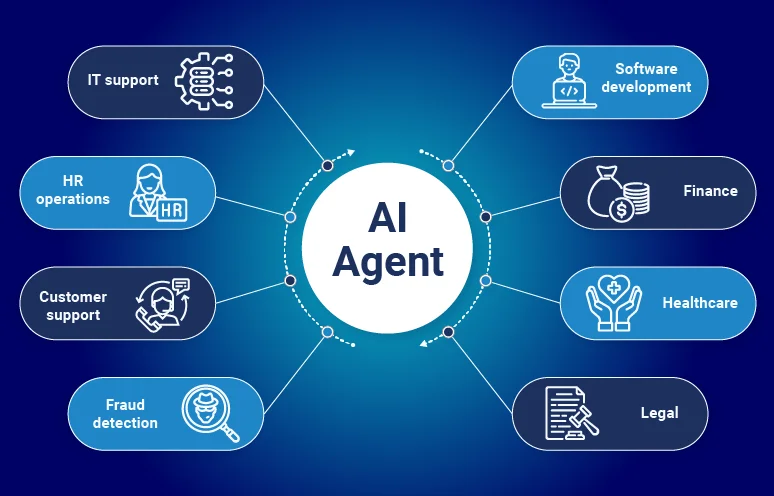
- Software Development: Analyzing code, generating tests, and assisting with debugging.
- Customer Support: Checking order status, answering questions, and creating support tickets.
- Data Analysis: Retrieving information, identifying trends, and generating reports.
- Business Automation: Coordinating tasks across business applications.
- Education: Supporting personalized learning and programming practice.
- Research: Gathering information, comparing evidence, and preparing reports.
The effectiveness of these applications depends on data quality, tool access, system design, and human oversight.
7. What Is Multi-Agent AI?
Multi-agent AI involves multiple AI agents collaborating or coordinating to achieve a larger goal.
For example, an AI research application could use:
- Research Agent: Collects information.
- Analysis Agent: Identifies patterns and compares findings.
- Writing Agent: Creates the report.
- Review Agent: Checks the report for inconsistencies.
An orchestration component coordinates their activities.
However, multiple agents are not always better. For simple tasks, a single agent or a conventional workflow may be more efficient and reliable.
8. Agentic AI Architecture for Developers
Developers can build agentic applications using familiar software engineering technologies.
A simplified architecture looks like this:
        User Request
             |
             v
      ASP.NET Core API
             |
             v
          AI Agent
             |
       +-----+------+
       |            |
       v            v
    LLM Model    Agent Tools
                    |
              +-----+------+
              |            |
              v            v
           REST APIs    Database
              |            |
              +-----+------+
                    |
                    v
             Result Evaluation
                    |
                    v
              Final Response
A .NET developer could use:
- ASP.NET Core Web API for application endpoints.
- C# for business logic and tool execution.
- An AI model API for language understanding.
- Entity Framework Core for database access.
- SQL Server for application data and workflow state.
- Authentication and authorization to control access.
For security, expose specific functions rather than giving the AI unrestricted database access.
For example, an agent could call a GetMonthlySalesReport() function instead of executing arbitrary SQL commands.
9. How to Start Building Agentic AI
Developers can follow these steps:
- Learn LLM fundamentals and prompt engineering.
- Build a basic application that integrates an AI model.
- Add function calling or tool integration.
- Connect the application to an API or database through controlled functions.
- Implement a multi-step workflow with clear stopping conditions.
- Add authentication, authorization, logging, and execution limits.
- Test the application with realistic scenarios and failure cases.
Start with a small use case before introducing complex autonomous workflows.
10. Why Does Agentic AI Matter in 2026?
Agentic AI is attracting interest because it can help move AI applications from generating individual responses toward completing multi-step workflows.
Important developments include:
- More capable language models.
- Improved integration with APIs and external tools.
- AI-assisted software development.
- Workflow automation across business applications.
- Specialized agents for different tasks.
- Greater attention to AI security and evaluation.
However, not every task requires an AI agent. Predictable operations may be better handled by traditional software or rule-based automation.
The real opportunity is identifying tasks where flexible reasoning and controlled action provide measurable benefits.
11. Challenges and Limitations of Agentic AI
Despite its potential, Agentic AI has several challenges.
1. Incorrect Decisions: Agents can misunderstand instructions or select inappropriate actions.
2. Security Risks: Excessive permissions can expose sensitive data or allow unauthorized changes.
3. Prompt Injection: Malicious instructions in external content can attempt to manipulate an agent.
4. Operational Costs: Repeated model calls and unnecessary tool execution can increase expenses.
5. Debugging Complexity: Multi-step workflows can be difficult to troubleshoot.
6. Human Oversight: Consequential actions may require explicit approval.
Developers should implement least-privilege access, input validation, monitoring, execution limits, and approval mechanisms for sensitive operations.
12. Will Agentic AI Replace Software Developers?
Agentic AI can automate parts of software development, including code generation, test creation, documentation, and debugging assistance.
However, software engineering involves much more than writing code.
Developers must understand system architecture, business requirements, security, databases, testing, and production reliability.
Learning how to integrate AI into software applications can help developers adapt to changing industry requirements.
For .NET developers, combining C#, ASP.NET Core, REST APIs, database design, and AI integration is a practical way to explore this field.
13. What Is the Future of Agentic AI?
Agentic AI is likely to remain an important area of AI development as organizations explore more integrated workflows and specialized agents.
Potential developments include:
- AI-assisted software engineering.
- Automated business workflows.
- Better coordination between agents.
- Improved tool interoperability.
- More reliable evaluation and monitoring.
- Stronger security and human-supervision mechanisms.
The long-term value of Agentic AI will depend on whether these systems can deliver reliable results while remaining secure, controllable, and cost-effective.
Conclusion
Agentic AI represents a shift from AI systems that primarily generate responses toward systems that can work through multiple steps to achieve defined goals.
By combining language models, planning, tools, memory, and controlled execution, developers can build applications that automate useful tasks.
For software developers, understanding Agentic AI creates opportunities to explore intelligent automation and modern AI application architecture.
The goal is not simply to build AI that can answer questions, but to build AI systems that can take useful, controlled, and verifiable actions.
Frequently Asked Questions
1. What is Agentic AI in simple words?
Agentic AI enables AI systems to work toward goals by planning tasks and using available tools.
2. What is the difference between Agentic AI and Generative AI?
Generative AI creates content, while Agentic AI focuses on achieving goals through planning and actions. An agent can use generative AI as one of its components.
3. Can I build Agentic AI using C# and .NET?
Yes. C# and ASP.NET Core can be used to integrate AI models, expose tools, connect APIs, and implement secure workflows.
4. What is a multi-agent AI system?
It is a system in which multiple agents coordinate their work to achieve a larger objective.
5. Is Agentic AI safe?
It can be designed to operate safely using restricted permissions, validation, monitoring, and human approval for consequential actions.